
The Northern Lakes: England’s Last Proper Wilderness
Here’s the thing about the Lake District: it shouldn’t exist.
A compact mountain range in the middle of England, sixteen lakes crammed into 912 square miles, peaks that would be respectable in the Alps but happen to be two hours from Manchester—it’s geological improbability dressed as countryside. The Romans marched past it. The Victorians discovered it. The National Trust preserved it. And somehow, despite 20 million annual visitors, it still feels wild in ways that Britain rarely allows.
This isn’t gentle. This is the England that bites back.
The Northern Lakes: Where It Gets Serious
The Lake District divides into north and south, and the division matters.
The south—Windermere, Ambleside, Bowness—is where most visitors go. The infrastructure exists. The car parks are numerous. The fudge shops proliferate. It’s lovely, genuinely, but it’s also managed in ways that file down the edges.
The northern lakes are different. Derwentwater, Buttermere, Crummock Water, Bassenthwaite, Ullswater, Thirlmere—these are the lakes where you can still find silence. Where the fells rise more dramatically. Where the weather reminds you that nature isn’t a backdrop for your Instagram content.
This is where Wainwright walked. Where the Romantic poets lost their minds. Where England gets properly, dramatically beautiful.
Derwentwater: The Queen of the Lakes
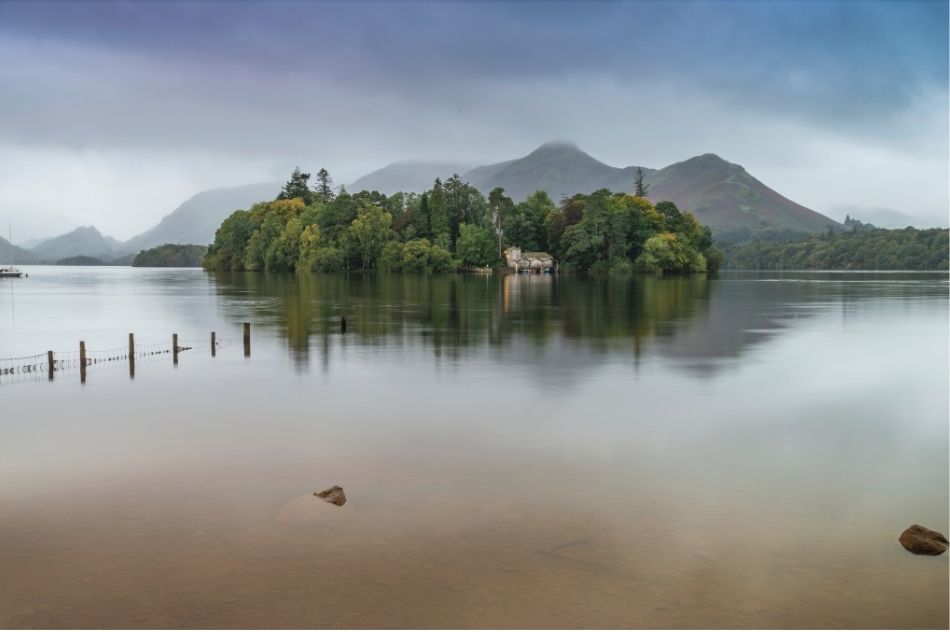
Derwentwater earned its title. Three miles long, a mile wide, surrounded by fells that rise directly from the water’s edge, dotted with islands that look like someone scattered them for effect—it’s theatrical in ways that make you understand why the Romantics kept coming back.
Keswick sits at the northern end, a market town that’s been catering to outdoor types since tourists became a concept. The shops are almost aggressively practical—walking boots, waterproofs, the kind of equipment that assumes you’re actually going to use it. The Theatre by the Lake does professional productions year-round. The Pencil Museum exists because, well, someone had to.
The Keswick Launch circles the lake, stopping at jetties that access different walks. Get off at Ashness Bridge for the most photographed view in the Lake District—the stone bridge framing Derwentwater with Skiddaw beyond. Get off at Hawse End for the walk to Catbells, the fell that introduces children to mountains and reminds adults what their knees used to do. Get off at Lodore for the falls that Southey wrote a poem about—’The Cataract of Lodore’—which is absurdly over-the-top but somehow appropriate.
Buttermere: The Secret That Stopped Being Secret
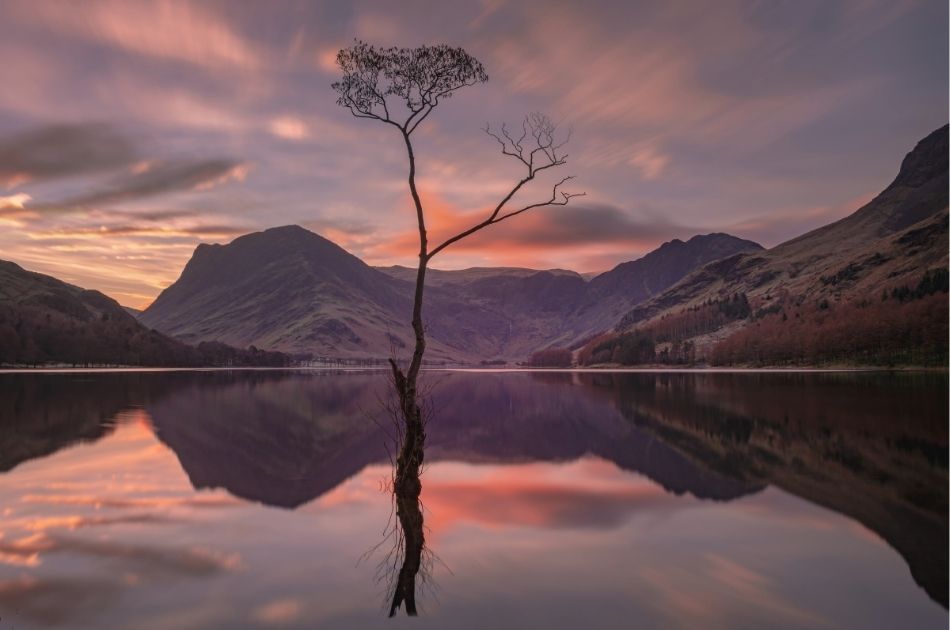
Buttermere is what happens when a place becomes famous for being unknown.
The valley contains two lakes—Buttermere and Crummock Water—separated by a flat field where the village sits. The road in is narrow, the car park is small, and the walks are exceptional. The circuit of Buttermere itself is four miles of flat waterside path, accessible to anyone who can walk at all. The fell walks above—Haystacks, Fleetwith Pike, Red Pike—are among the best in the district.
Haystacks was Wainwright’s favourite mountain. The great guidebook writer asked for his ashes to be scattered on its summit, and they were, in 1991. ‘I just want to lie here and watch the rain clouds drift by and hear the lambs crying on the fell,’ he wrote. That’s exactly what it feels like.
The Fish Inn and Bridge Hotel provide the only accommodation in the village. Book ahead. Seriously. There are maybe thirty beds in the entire valley, and everyone wants to wake up here.
Ullswater: The Drama Queen
Ullswater is seven miles long, England’s second-largest lake, and shaped like a bent arm that reveals itself view by view as you travel its length. Each bend brings a different perspective. The Victorians called it the most beautiful of the lakes. They weren’t wrong.
The Ullswater Steamer has been running since 1859—the same company, the same route, the same sense that some things shouldn’t change. The boats connect Glenridding at the south end to Pooley Bridge at the north, with Howtown in the middle. The classic day: take the boat to Howtown, walk back to Glenridding along the shore path, seven miles of lakeside and fell-side that justify every superlative.
Wordsworth saw his daffodils at Glencoyne Bay, on Ullswater’s western shore. ‘I wandered lonely as a cloud’ started here, in spring, with actual daffodils. They still bloom every March and April. The National Trust plants 8,000 bulbs annually to maintain the effect. Literature as landscaping.
Helvellyn rises directly from Ullswater’s southern end. At 950 metres, it’s England’s third-highest peak. Striding Edge—the knife-edge ridge that approaches the summit from the east—is the most famous scramble in England. It’s not technical, but it’s exposed. People die here. But more people return, again and again, because there’s nothing else like it south of Scotland.
The Walking That Matters
Let’s be direct: you don’t come to the northern lakes to shop. You come to walk.
Catbells (451m) is the introduction. Two hours up and down, views of Derwentwater that explain everything. Children do it. Grandparents do it. You should do it.
Skiddaw (931m) is the big one that’s actually accessible. The path from Keswick is relentless but not technical—just up, and up, and up. On clear days, you can see Scotland, the Isle of Man, the Pennines, the sea. On unclear days, you see cloud and wonder why you bothered. Both experiences are valid.
Blencathra (868m) is the connoisseur’s choice. Sharp Edge is the scrambler’s approach—a genuine knife-edge ridge that requires hands and nerve. Hall’s Fell is the walker’s alternative—steep but never exposed. The summit feels earned because it is.
Wainwright wrote guides to 214 fells. People spend lifetimes completing them. The obsession is partly the walking, partly the views, partly the simple human need to make progress visible. A tick in a book for each summit. A life measured in mountains.
Staying and Eating
The northern lakes have accommodation that ranges from YHA hostels in converted mansions to country house hotels that charge accordingly.
The Inn on the Lake at Glenridding puts you on Ullswater’s shore. The Lodore Falls Hotel at Derwentwater has the waterfall in its grounds. The Pheasant at Bassenthwaite is properly old—beams, fires, the sense that people have been eating and drinking here for centuries because they have.
For food, the northern lakes punch above their weight. The Cottage in the Wood near Keswick has Michelin recognition—five courses of Cumbrian ingredients with views down the Skiddaw forest. Fellpack in Keswick does gourmet hiking food—the kind of sandwiches that make picnics feel inadequate anywhere else. The Old Keswickian does fish and chips that hikers queue for because calories matter after 12 miles of fell.
The pubs are properly pubby. The Dog and Gun in Keswick. The Horse and Farrier at Threlkeld. The Fish at Buttermere. Real ale, open fires, dog-friendly to a fault. This isn’t the Lakes that puts doilies under everything. This is the Lakes that expects you to arrive muddy and doesn’t care.
Why The Northern Lakes Matter
The northern lakes matter because they’re difficult.
The weather changes in minutes. The paths are rough. The fells don’t come with handrails or guarantees. This is landscape that requires something from you—preparation, respect, the willingness to turn back when conditions demand it. People have died on these hills because they underestimated them. People die every year.
But that difficulty is the point. This is England’s last proper wilderness—not manicured countryside, not heritage preservation, but actual wild land where the mountains set the terms. Stand on Helvellyn’s summit in clear weather and the view stretches to Scotland. Stand there in cloud and you can’t see your own feet. Both experiences are the Lake District. Both are why people keep returning.
Wordsworth understood this. Wainwright understood this. The 20 million annual visitors—some of them understand it too. The ones who don’t go home and complain about the weather. The ones who do go home and start planning their return.
Come expecting pretty. Leave understanding wild.
That’s the northern lakes. Uncompromising, beautiful, and completely itself.
Worth the drive through narrow roads and sudden rain? Every single time.