
THE HOTEL THAT WAS BUILT TO KEEP SECRETS

Forget the thread count. For the world’s most recognisable travellers, the ultimate luxury is privacy, time, and a hotel that can make an entire London trip disappear behind one set of doors. Corinthia London has been in that business for longer than most people realise.
There are plenty of five-star hotels in London. There are hotels with famous names, famous restaurants and addresses that have been printed on postcards for generations.
And then there are hotels that seem to be working from a slightly different definition of the word.
Corinthia London is one of them, and the interesting question is not why somebody would pay a small fortune to stay there. Money buys marble everywhere. The question is why, when every hotel on earth is available to you and none of them would dream of saying no, you keep choosing this one.
The answer is not on the room service menu.

A building with form
Start with the address, because the address is doing more work than it appears to.
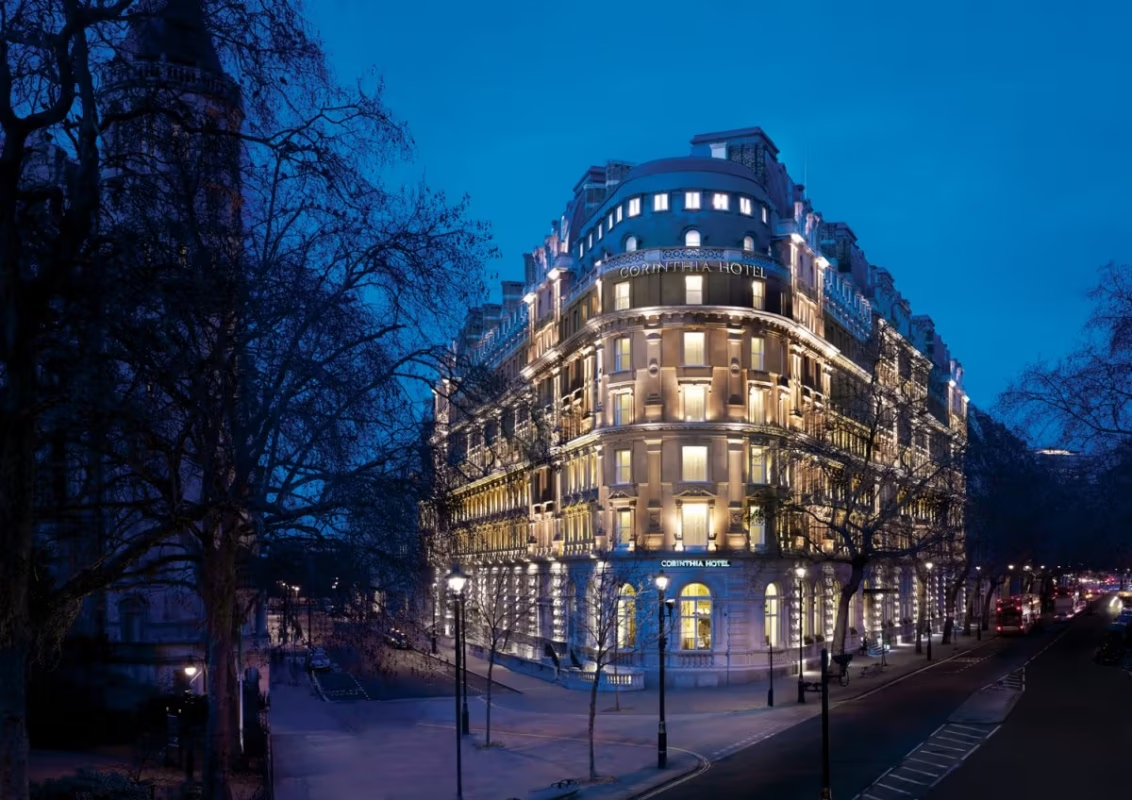
The hotel occupies a great wedge of Victorian stone on Whitehall Place, a few minutes from Trafalgar Square and the river. It opened in 1885 as the Hotel Métropole, one of the grand railway-age hotels built for people who arrived in London with trunks and stayed for the season.
Then the government took an interest.
The building was requisitioned during the First World War, handed back, and taken over again during the Second. For most of the twentieth century it was not a hotel at all. It was the Metropole Building, a warren of civil servants and wartime departments, and it is widely reported to have housed branches of Britain’s secret services, the people whose entire profession was arranging for other people to move through the world unnoticed.
The Ministry of Defence held on to it until the mid-2000s. It reopened as Corinthia in 2011.
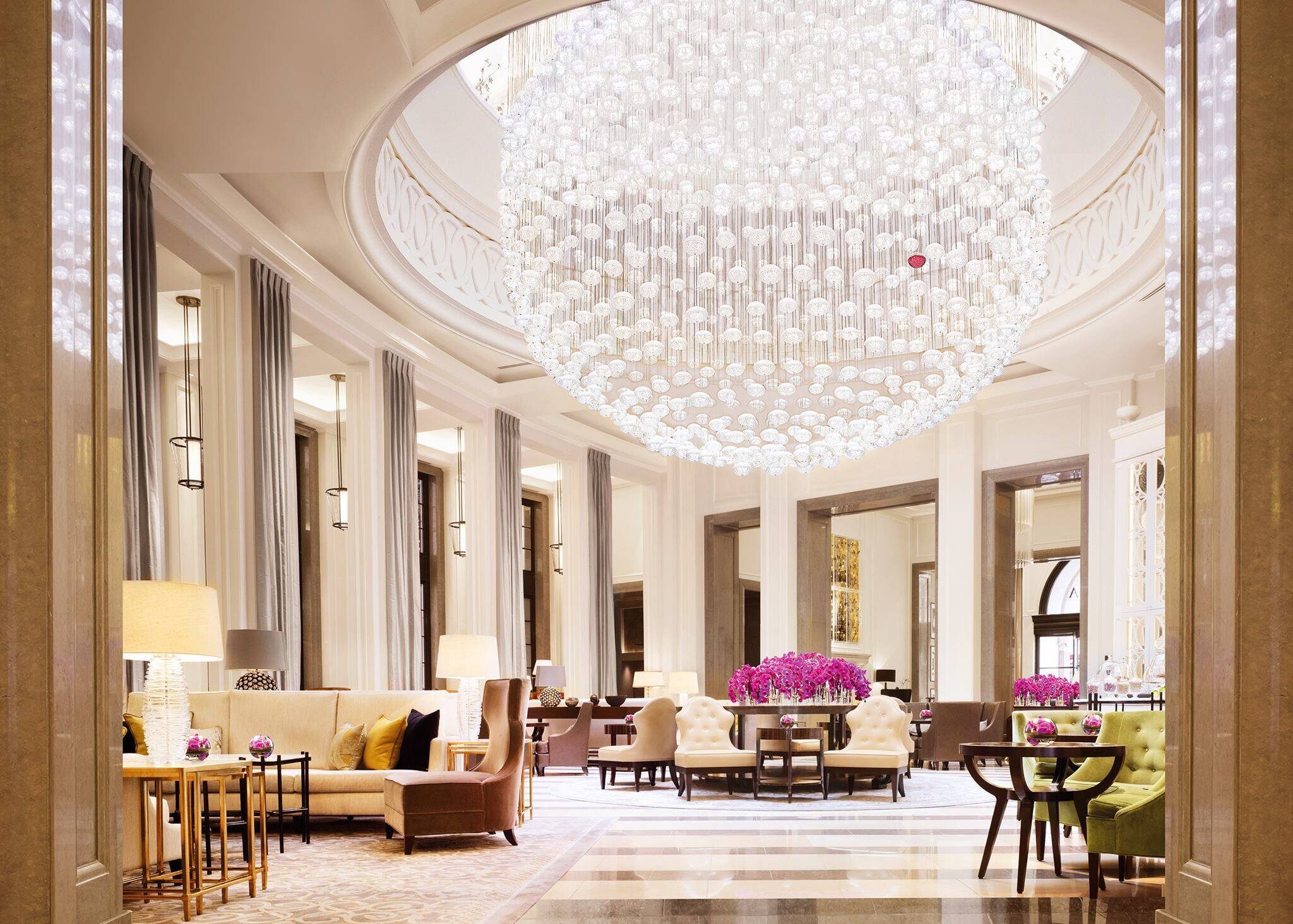
So there is a pleasing symmetry in what the building sells today. It spent decades as a place where nobody was supposed to know who was inside, and it has quietly gone back to the same trade, only now the guests arrive by their own choice and the discretion comes with a Baccarat chandelier.
That history matters for a practical reason as well. Buildings designed for the Victorian rich and then adapted for government work tend to have something modern hotels struggle to buy: separate entrances, back stairs, lifts that go where you need them to, and rooms large enough to hold a meeting in. Privacy is not only a policy. It is architecture.
When a hotel becomes a private residence
At the top of the building, the word “room” starts to feel inadequate.
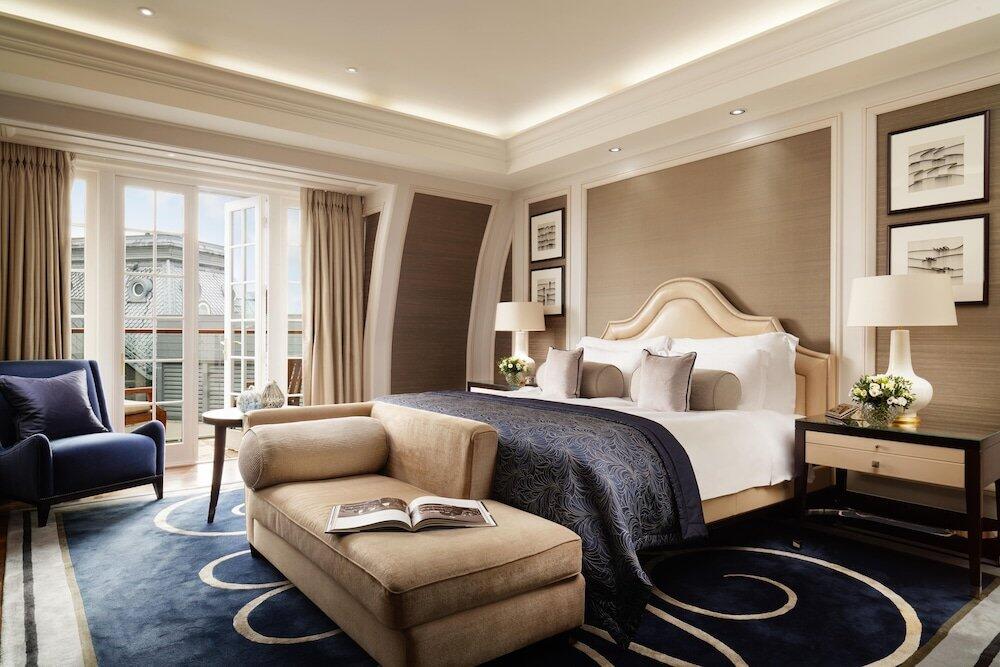
The hotel’s penthouses run under names rather than numbers: the Hamilton, the Royal, the Actor’s, the Musician’s and the Whitehall, each with a character of its own.
The Hamilton stretches across more than 200 square metres and opens onto a terrace above the rooftops, with an outdoor jacuzzi and a fire pit. There is a kitchen, a dining room and a wine cellar. A butler handles the rest.
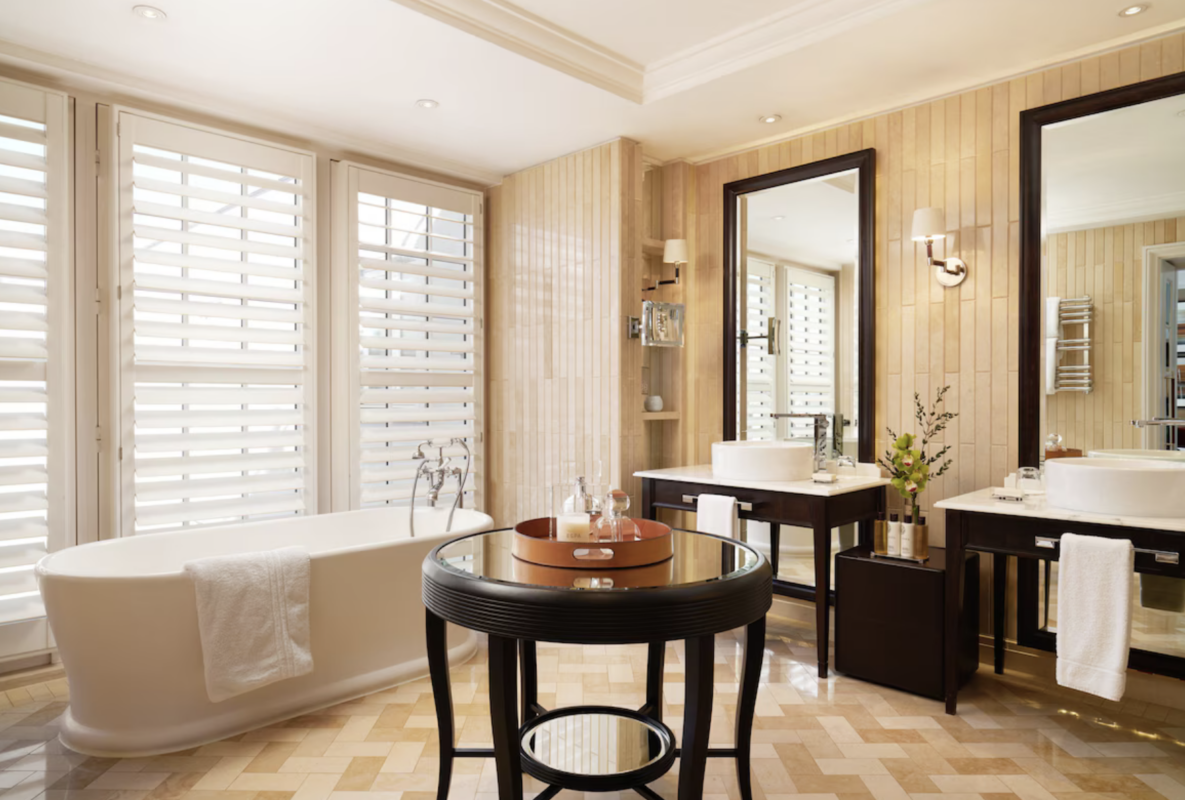
The Royal Penthouse goes further again: two floors, panoramic views towards the Thames, a private spa suite, a ten-seat dining room, kitchen and cellar. You could conduct a small piece of diplomacy in it without ever booking a table.
The Actor’s Penthouse feels almost deliberately built for somebody whose life is spent in transit. Terrace, fireplace, walk-in wardrobe, private wine cabinet, and the sort of arrangements (airport transfers, pressing, dining in the suite) that let a guest stay inside their own weather system for as long as they like.
For most of us, a luxury hotel is somewhere you escape to.
For a guest at this end of the market, the best hotel is somewhere you never need to escape from.

The reason you never have to leave
Of course, the most expensive suite in London loses its charm rather quickly if you have to put a coat on every time you want something worth eating.
Corinthia has closed that gap deliberately.
At Kerridge’s Bar & Grill, Tom Kerridge’s cooking is unapologetically British. This is not the kind of luxury that turns dinner into an architectural experiment. It takes familiar things and makes them very, very good, which is a far harder trick and a much rarer one.
The dish people talk about is the pig’s cheek pie with clotted-cream mash.
It sounds almost comically ordinary until you remember where you are sitting. There is something genuinely funny about a hotel catering to some of the wealthiest people alive, in which one of the most talked-about plates is an exceptionally good pie. The restaurant’s fish and chips has developed a following of its own.
Luxury, it turns out, does not always mean abandoning the familiar. Sometimes it means somebody has taken the thing you already love and refused to compromise on it.
Elsewhere in the building, Francesco Mazzei brings southern Italian cooking to Mezzogiorno, and Velvet by Salvatore Calabrese takes a grown-up view of cocktails and Champagne; Calabrese is a man who has built a career on the proposition that a drink can be a piece of scholarship.
Serious dinner, late drink, or something comforting at the end of a long day. None of it requires a car.
If you are travelling with security, an assistant, a schedule and a driver, not going anywhere is a luxury in itself.
Twenty-six teas, and somebody who knows which one
Then there is afternoon tea, which the hotel has escalated into something close to performance art.
The Crystal Moon Lounge sits beneath an extraordinary Baccarat chandelier, and the tea is served with the sandwiches, scones and patisserie you would expect, alongside a list of teas that has, at times, run to twenty-six, with a tea sommelier on hand to guide you through it.
It sounds absurd, and it is absurd, and it tells you almost everything about the psychology of this end of the market.
The very wealthy are not, on the whole, chasing something nobody else can have. They have already had that, and it was less interesting than advertised. What they want is choice, and more precisely, they want choice that somebody else has already thought about on their behalf.
Twenty-six teas is unnecessary. A specialist to recommend one is arguably more unnecessary still.
But when the entire proposition is that somebody has considered the details so you do not have to, the unnecessary stops being excess and becomes the actual product.
Four floors of disappearing
There is one more reason a guest can spend three days here without feeling shut in.
Biome by Corinthia London occupies four floors: treatments, thermal experiences and recovery, with a vitality pool, sauna, steam room, cold plunge and heated loungers, and treatments from names that people in the wellness industry actually recognise.
None of which is unique on its own. Every serious five-star hotel in London now has an impressive spa.
The difference is the accumulation.
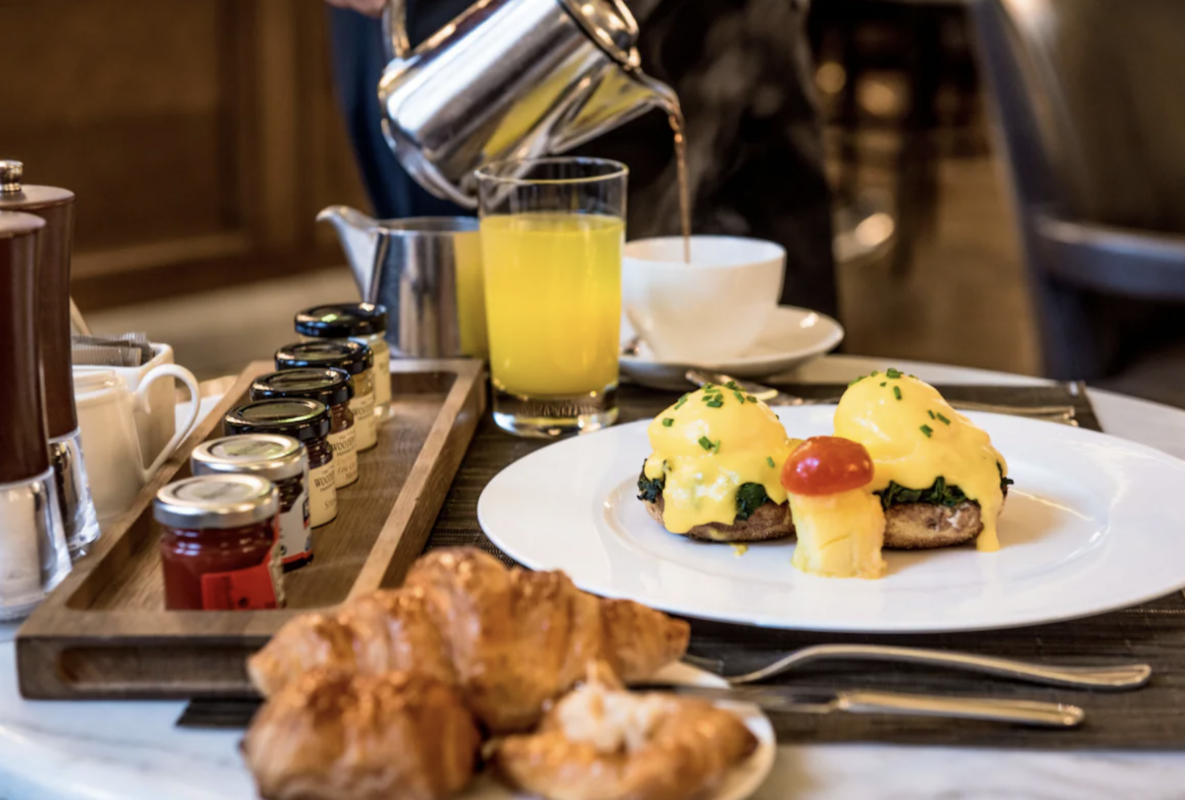
You can wake in a private penthouse, take breakfast without opening your door, spend the morning in meetings, vanish downstairs for the afternoon, have a cocktail, eat a very good dinner and go back upstairs, having dealt with the outside world precisely never.
For somebody who has spent a career negotiating airports, photographers, boardrooms and other people’s diaries, that is not indulgence.
It is relief.

What they are actually buying
This is where the appeal becomes more interesting than the price list.
The people who can afford the top of this hotel do not need another building to tell them how successful they are. They have that information. What they need is somewhere that understands they may wish to be left alone, and that has the layout, the staff and the instincts to arrange it without being asked twice.
In practice that means a private dining room rather than a restaurant table. A butler rather than a reception desk. A car at the kerb rather than a queue. A treatment two floors down rather than a journey across London. A meal upstairs rather than an evening spent being recognised.
The hotel becomes less about what it adds to your day and more about what it removes from it.
The new definition of luxury
Luxury used to be easy to spot. Marble, chandeliers, a suite the size of a flat, a car with somebody else driving it and a bottle of something cold on arrival.
All of that still counts. But for people who can buy nearly anything, another ten thousand pound suite does not change the shape of a week.
Saving an hour might. Avoiding a crowded room might. Having somebody know how you take your tea before you have said a word might.
Corinthia has understood this and built around it. The spectacle is all there, the penthouses and the crystal and the views over the river, but underneath it is something far harder to manufacture and impossible to fake.
It makes London feel effortless.
Outside, the city is loud, crowded and permanently demanding your attention.
Inside, somebody else is dealing with it.
Which is, in the end, what the building has always been for. It was requisitioned once because the state needed somewhere people could come and go without being noticed. It now performs the same service for anyone who can afford it.
Not more luxury. Less to worry about.
Practical Information
Whitehall Place
London SW1A 2BD
United Kingdom
Tel : +44 20 7930 8181
Email address: london@corinthia.com
About Author
Chris Owen is a seasoned editorial strategist, brand marketer, and travel storyteller, Chris Owen has built his career at the intersection of compelling content and commercial impact.