
Old Town & New Town: Two Cities, One Soul
“Edinburgh is a mad god’s dream, jumbled together in a beautiful mess of ancient stone and modern aspiration.”
— Adapted from Jan Morris
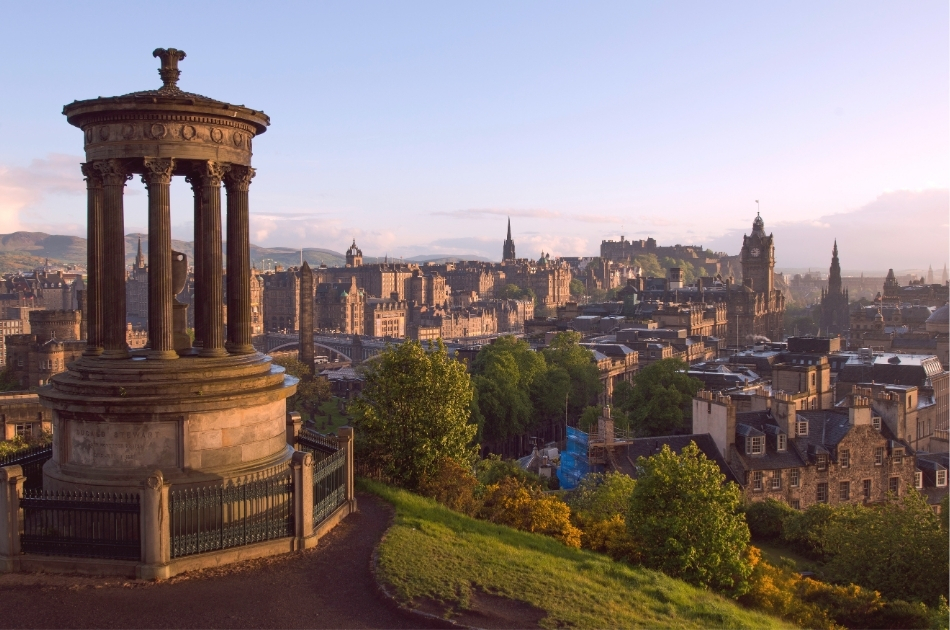
Few cities wear their history as visibly as Edinburgh, and fewer still have had the architectural good sense to preserve it. The Old Town and New Town together form a UNESCO World Heritage Site—a designation earned not merely for individual buildings but for the extraordinary dialogue between two urban philosophies sitting side by side. Step into the Old Town and you are immediately swallowed by centuries of accumulated life: narrow closes, towering tenements, stone worn smooth by generations of footsteps. Cross Princes Street and suddenly you are in the New Town—airy, elegant, and unapologetically Georgian. The contrast is so stark, so deliberate, that it reads like a thesis on urban evolution.
The Old Town: Edinburgh’s Medieval Heart
The Old Town grew upward because it could not grow outward. Constrained by defensive walls and the natural topography of the volcanic ridge running from the castle to Holyrood, medieval Edinburgh became one of Europe’s first high-rise cities. The Flodden Wall, constructed after Scotland’s catastrophic defeat in 1513, defined the city’s boundaries for centuries; within these limits, population pressure forced buildings ever higher. Tenements of ten, twelve, even fourteen storeys lined the Royal Mile, creating a density of habitation that would not be seen again until 19th-century New York.
This vertical city created a distinctive social atmosphere. In the ‘lands’ (as the tenement buildings were called), social stratification operated by floor rather than neighbourhood. The wealthy occupied the middle storeys—above the street-level filth but below the exhausting climb to upper floors—while the poor crammed into attics and cellars. Lawyers shared staircases with labourers; professors and prostitutes were neighbours. The forced proximity created what one historian called ‘a democracy of shared inconvenience.’
The Old Town’s closes and wynds—those narrow passages descending from the Royal Mile—remain the best portals into this vanished world. Each name tells a story: Advocate’s Close recalls the legal profession; Fleshmarket Close was the site of the meat market; Bakehouse Close housed the city’s bakers. Some names hint at darker histories. The Old Town was not romantic to those who lived in it; it was crowded, smelly, occasionally violent, and regularly visited by plague. The cry of ‘Gardyloo!’—warning pedestrians of chamber pot contents about to descend from windows above—was not colourful local custom but necessary survival information.
“The Old Town of Edinburgh is the most picturesque in the world, though in an earlier period it was also the dirtiest.”
— Lord Cockburn, Memorials of His Time
The Scottish Enlightenment and Urban Crisis
By the mid-18th century, Edinburgh had become simultaneously one of Europe’s most intellectually vibrant cities and one of its most physically degraded. David Hume, Adam Smith, James Hutton, and Joseph Black—giants of philosophy, economics, geology, and chemistry—lived and worked within the Old Town’s cramped confines. The Royal Society of Edinburgh, the Medical School, and the University attracted scholars from across Europe. Yet the streets these luminaries walked were ankle-deep in refuse, the buildings were crumbling, and the overcrowding had become genuinely dangerous.
The Lord Provost, George Drummond, envisioned a solution: a planned expansion north of the Old Town, across the drained Nor’ Loch (now Princes Street Gardens), offering a new kind of urban living. In 1767, a competition was held for the design; the winner was James Craig, a 23-year-old architect whose elegant grid pattern would transform Edinburgh’s identity.
The New Town: Enlightenment in Stone
Craig’s plan was deceptively simple: a grid of three main parallel streets—Princes Street, George Street, and Queen Street—intersected by connecting streets and anchored by squares at each end. What elevated this from competent town planning to something more was the execution. The New Town became a showcase for Georgian architecture at its finest: symmetrical terraces, unified facades, and a restraint that let proportion and detail speak rather than ostentation.
The first New Town, completed by the 1820s, was followed by successive northern extensions that maintained the essential character while adding variety. Charlotte Square, designed by Robert Adam in 1791, is considered among the finest examples of Georgian urban architecture anywhere in Europe. The square’s north side, including what is now Bute House (official residence of Scotland’s First Minister), demonstrates how formality and elegance can coexist with human scale.
The New Town attracted Edinburgh’s aspirational classes. Lawyers, merchants, and professionals abandoned the Old Town’s vertical democracy for horizontal respectability. Addresses began to matter in new ways; being on the ‘right’ side of Princes Street carried social implications that persisted well into the 20th century. The Old Town, meanwhile, slid into poverty and neglect—a trajectory that would only reverse when Victorian preservationists and 20th-century regeneration efforts recognised what had nearly been lost.
“In the New Town, everything seems in its right place. In the Old Town, nothing is—which is precisely its charm.”
— Robert Louis Stevenson
A Tale of Two Towns Today
What makes Edinburgh special is that neither town dominates. They coexist in productive tension, each illuminating the other. You can sip coffee in a sleek New Town café, all clean lines and Scandinavian minimalism, then wander ten minutes and find yourself in a candlelit Old Town pub where the ceiling beams have sagged under four centuries of accumulated atmosphere. The Georgian order of Queen Street gives way to the medieval chaos of the Grassmarket; the formal gardens of Charlotte Square contrast with the wild expanse of Holyrood Park.
Locals move between the two without conscious thought. A New Town office worker might lunch in the Old Town; an Old Town resident might swim at the New Town’s Royal Commonwealth Pool. The class distinctions that once divided these territories have softened, though not disappeared entirely—Edinburgh remains acutely aware of its own geography in ways that other cities might find puzzling.
For visitors, the dual character offers richness that single-identity cities cannot match. The recommended approach is immersion in both: not a day in the Old Town followed by a day in the New, but a constant crossing and recrossing until the two begin to feel like complementary aspects of a single personality. Edinburgh’s story is written in the contrast between medieval survival and Georgian aspiration; to read only one chapter is to miss the point entirely.
As the Scots proverb has it: ‘Mony a mickle maks a muckle’—many small things make a big thing. Edinburgh’s greatness lies not in any single building or street but in the accumulation: a city that contains multitudes and makes no apology for the contradictions.